
Small and medium-sized enterprises (SMEs) have traditionally struggled with financial management. Many founders still spend hours reconciling transactions, updating spreadsheets, chasing invoices, calculating payroll, and trying to understand where their cash is going.
Today, things are changing rapidly.
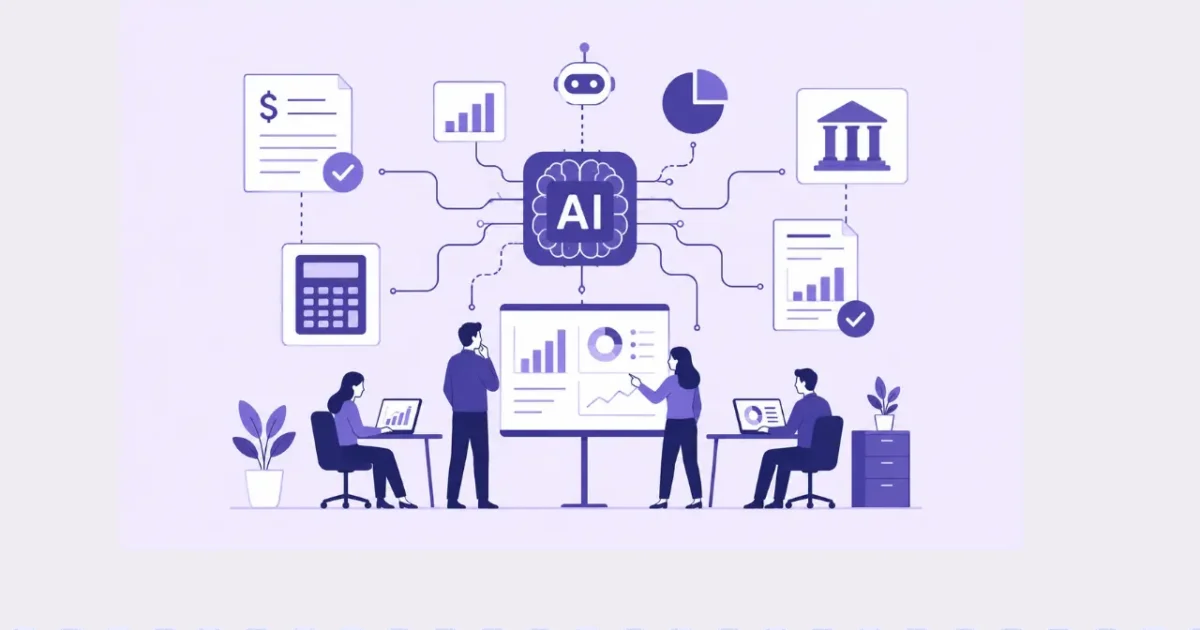
AI in financial operations is helping SMEs automate repetitive tasks, gain better visibility into their finances, and make faster decisions without building large finance teams.
What was once only accessible to large corporations with dedicated finance departments is now becoming available to growing businesses through affordable software and intelligent platforms.
This shift is allowing SMEs to spend less time managing finances and more time building sustainable businesses.
Why Financial Operations Have Become More Complex for SMEs
Managing business finances is becoming increasingly difficult as companies grow.
A small business that once handled ten transactions a week may suddenly find itself processing hundreds of payments, subscriptions, vendor invoices, employee salaries, and tax obligations every month.
For many founders, growth introduces operational challenges they never anticipated.
Take Sarah, for example.
Sarah runs a digital marketing agency with twelve employees. In her first year, she managed finances using spreadsheets and online banking apps. At first, everything seemed manageable.
However, as new clients signed on, she began spending weekends matching receipts, calculating payroll deductions, tracking software subscriptions, and following up on unpaid invoices.
She realized she was spending nearly fifteen hours every week on administrative finance tasks.
Her turning point came when she adopted tools that leveraged AI in financial operations. Instead of manually reviewing reports, she started receiving automated insights showing spending trends, expected cash shortages, and overdue payments.
Within months, she reclaimed valuable time that she redirected toward serving clients and growing revenue.
Stories like Sarah’s are becoming increasingly common among SMEs worldwide.
How AI Is Transforming Financial Operations
Artificial intelligence is not replacing finance professionals. Instead, it is helping businesses work smarter.
Several key areas are seeing major improvements.

1. Automated Bookkeeping Reduces Manual Work
Bookkeeping is one of the most time-consuming responsibilities for SMEs.
Recording transactions manually often leads to errors, duplicate entries, and incomplete records.
With AI accounting and automated bookkeeping, businesses can categorize expenses automatically, reconcile transactions faster, and maintain more accurate financial records.
Machine learning systems can recognize spending patterns and suggest appropriate accounting classifications based on historical behavior.
As a result, finance teams spend less time entering data and more time analyzing business performance.
Research on AI adoption for SME financial decision-making highlights that incremental implementation of AI solutions can significantly improve operational efficiency while minimizing resource constraints for growing businesses.
2. Smarter Cash Flow Forecasting
Cash flow problems remain one of the leading reasons SMEs struggle to scale.
Business owners often know how much money they have today but struggle to predict what their financial position will look like next month.
This is where cash flow forecasting powered by AI becomes valuable.
AI systems analyze historical revenue, seasonal patterns, recurring expenses, and customer payment behavior.
They can identify potential shortfalls weeks in advance.
Instead of reacting to financial problems after they occur, founders can proactively make decisions.
Businesses that understand future cash positions are better positioned to negotiate vendor payments, delay unnecessary spending, or pursue new growth opportunities.
AI Helps Businesses Make Better Decisions
Financial decisions should be based on evidence rather than assumptions.
Many SMEs still rely heavily on instinct.
However, modern business financial analytics tools provide decision-makers with actionable insights in real time.
AI can answer questions such as:
- Which customers consistently pay late?
- Which departments exceed budget allocations?
- What expenses are increasing fastest?
- How much runway does the business currently have?
These insights support stronger financial decision making and improve confidence when allocating resources.
Recent studies suggest that AI architectures designed specifically for SMEs can enhance reporting accuracy while remaining cost-efficient for resource-constrained businesses.
Payroll Automation Saves Time and Improves Compliance
Payroll processing is another area where SMEs experience significant challenges.
Manual salary calculations increase the risk of errors, delayed payments, and compliance issues.
Through payroll automation, businesses can calculate deductions, pensions, taxes, and employee benefits automatically.
Platforms such as Paycape are helping businesses simplify these processes.
Using Paycape Payroll, companies can process employee salaries, generate payslips, and stay compliant without relying on spreadsheets.
For founders managing growing teams, this reduces stress and improves employee satisfaction.
Expense Management Is Becoming More Intelligent
Expense tracking is often neglected until spending becomes difficult to control.
AI-powered systems can now monitor employee expenses, identify unusual transactions, and provide alerts when budgets are close to being exceeded.

Paycape’s expense management capabilities enable businesses to centralize receipts, approvals, and spending data from one dashboard.
Businesses can also leverage expense management software alongside budgeting tools to establish stronger financial controls.
By combining AI insights with spending policies, organizations reduce waste and improve accountability.
Subscription Tracking and Recurring Revenue Management
Modern businesses depend heavily on software subscriptions.
Unfortunately, many companies lose money paying for tools they no longer use.
Subscription management supported by AI helps businesses monitor recurring charges, forecast upcoming expenses, and identify redundant services.
Paycape’s subscription management tool allows SMEs to oversee recurring payments while maintaining visibility into overall cash flow.
For SaaS companies and service businesses, this level of oversight contributes significantly to healthier financial planning.
Why SMEs Should Adopt AI Gradually
Despite the advantages, many SMEs hesitate to invest in AI because they assume implementation will be expensive or technically complicated.
Fortunately, adoption does not need to happen all at once.
Businesses can begin by automating one process at a time.
Examples include:
- Payroll management
- Invoice processing
- Budget tracking
- Accounts payable automation
- Financial reporting
- Cash flow monitoring
Paycape provides SMEs with a practical starting point by bringing payments, payroll, expenses, subscriptions, and budgeting together within one platform designed for growing African businesses.
Businesses can use Paycape Payments to streamline collections, Paycape Budgets to monitor departmental spending, Paycape Expenses to gain visibility into costs, and Paycape Subscriptions to control recurring commitments.
By implementing these tools gradually, SMEs can build confidence while experiencing immediate operational improvements.
Frequently Asked Questions
What is AI in financial operations?
AI in financial operations refers to the use of artificial intelligence technologies to automate accounting, forecasting, payroll, reporting, and financial analysis tasks.
How can SMEs benefit from AI accounting?
AI accounting helps SMEs reduce manual work, improve accuracy, gain real-time insights, and make better financial decisions.
Is AI expensive for small businesses?
Not necessarily. Many modern finance platforms offer affordable AI-powered features that allow businesses to adopt automation gradually.
Which financial processes should SMEs automate first?
SMEs should typically start with payroll, expense tracking, invoicing, budgeting, and cash flow forecasting because these areas often deliver the quickest returns.
Conclusion
Artificial intelligence is no longer reserved for multinational corporations.
Today, AI in financial operations is helping SMEs automate repetitive tasks, improve forecasting, strengthen compliance, and make smarter financial decisions.
Businesses that embrace financial automation, AI-powered accounting, and modern finance platforms are positioning themselves for sustainable growth in an increasingly competitive environment.
Paycape was built to help African businesses simplify financial operations through integrated payroll, payments, budgets, expenses, subscriptions, and reporting tools. Instead of juggling spreadsheets and disconnected applications, SMEs can manage their finances from one centralized workspace.
Ready to spend less time managing finances and more time growing your business? Start your journey with Paycape today and create your free account now.